

How Infrared Passenger Detection Makes Taxi Advertising Displays Smarter
As digital advertising continues to develop, taxi advertising displays are becoming more intelligent. Instead of continuously playing advertisements regardless of whether a passenger is inside the vehicle, modern systems can use infrared passenger detection to determine whether the rear seat is occupied.
For a professional taxi advertising display manufacturer, integrating a PIR (Passive Infrared) sensor into the advertising display provides new possibilities for intelligent advertising playback and passenger data collection.taxi advertising display manufacturer
The basic concept is simple:
Passenger detected → Start advertising
No passenger detected → Enter standby mode
This function can improve the efficiency of advertising playback while also helping operators reduce unnecessary screen operation.taxi advertising display manufacturer
1. Automatically Play Ads When a Passenger Enters
One of the main applications of infrared passenger detection is automatic advertising playback.
When a passenger enters the taxi and sits in the rear seat, the infrared sensor detects the passenger’s presence.
The system can then automatically:
- Detect the passenger;
- Wake up the advertising display;
- Start the advertising content.
This means the advertising screen does not need to continuously play content when nobody is watching.
For taxi advertising operators, this can make advertising playback more closely connected with the actual passenger environment.
2. Enter Standby Mode When the Passenger Leaves
The infrared sensor can also detect when the passenger leaves the vehicle.
After the system determines that there is no passenger, the advertising display can automatically enter standby mode.
This provides several potential benefits:
- Reduces unnecessary screen operation;
- Reduces power consumption;
- Reduces screen operating time;
- Creates a more comfortable environment for passengers.
When the next passenger enters the vehicle, the sensor detects the passenger again and the screen can automatically resume advertising playback.
This creates an automatic operating cycle:
Passenger enters → Screen wakes up → Advertisement plays → Passenger leaves → Screen enters standby
3. Passenger Counting Through CMS Integration
Infrared passenger detection can provide more than automatic screen control.
If the customer’s CMS platform supports customized protocol integration, the PIR sensor can also be connected to the CMS system.
Through customized communication protocols, the CMS can receive passenger detection information from the advertising display.
For example, the system can record:
- Passenger detection events;
- Number of passenger entries;
- Daily passenger count;
- Device-level passenger statistics.
This allows operators to use the advertising display as part of a broader passenger data management system.
For example, the CMS could generate a daily report showing the number of detected passengers for each taxi or advertising device.
4. Why Passenger Data Is Valuable for Taxi Advertising
Passenger data can provide useful information for advertising operators.
For example, if a fleet operates 500 taxis, the CMS can potentially collect passenger detection data from each connected device.
Operators may then analyze:
- Daily passenger traffic;
- Passenger activity by vehicle;
- Passenger activity by location;
- Advertising exposure opportunities.
This type of data can help advertising companies better understand the potential audience of their taxi media network.
However, the actual accuracy of passenger counting depends on the sensor installation position, vehicle environment, detection algorithm, and CMS integration method.
5. PIR Sensor and CMS Work Together
It is important to understand that the PIR sensor and CMS have different roles.
The PIR sensor is responsible for detecting passenger presence.
The CMS is responsible for receiving and processing the detection information and applying corresponding rules.
For example:
PIR Sensor → Passenger detected → CMS receives signal → Screen starts advertising
or:
PIR Sensor → No passenger detected → CMS/system receives status → Screen enters standby
With customized CMS protocol integration, the sensor can become part of a complete intelligent taxi advertising solution.
6. DHB Taxi Advertising Display Solutions
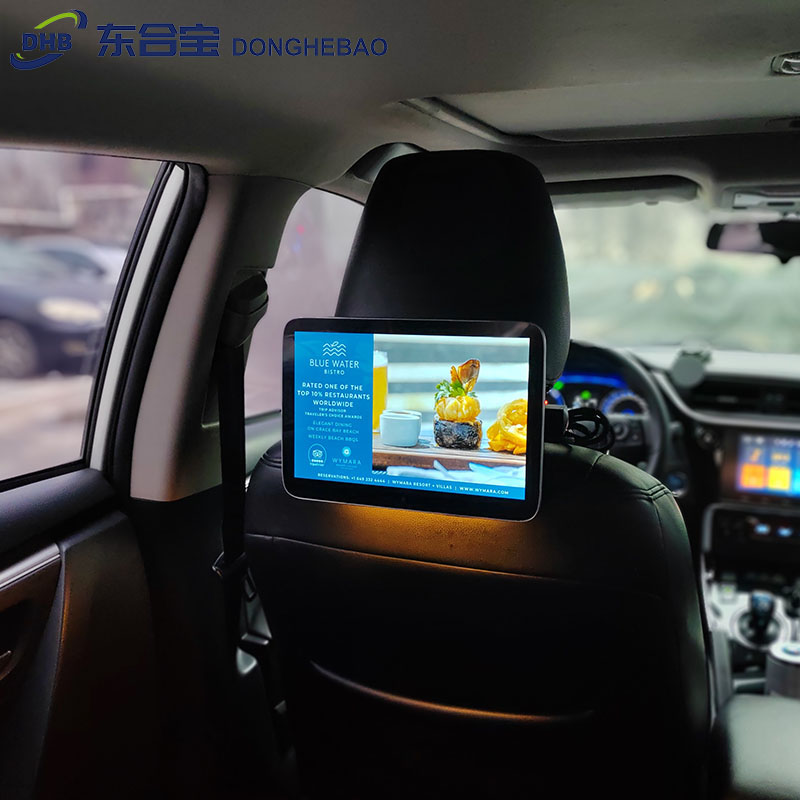
As a professional taxi advertising display manufacturer, DHB can provide taxi headrest advertising displays with optional PIR human detection functionality.
The PIR function can be customized according to the requirements of different projects.
Possible applications include:
- Automatic advertising playback;
- Passenger presence detection;
- Automatic standby;
- Passenger counting;
- CMS protocol integration;
- Daily passenger statistics.
For projects that require passenger counting or intelligent advertising delivery, DHB can also work with the customer’s CMS provider to discuss protocol integration and software customization.
Conclusion
Infrared passenger detection is a practical way to make a taxi advertising display more intelligent.
The basic application is straightforward:
When a passenger enters → the screen starts playing advertisements.
When the passenger leaves → the screen enters standby mode.
With customized CMS protocol integration, the PIR sensor can also provide passenger detection data for daily passenger counting and device-level statistics.
For taxi advertising companies and fleet operators, this creates opportunities to build a smarter advertising network that connects hardware, passenger detection, CMS management, and advertising data.
DHB provides professional taxi headrest advertising display solutions and can support customized PIR functionality and CMS integration according to project requirements.
FAQ
1. What is a PIR sensor in a taxi advertising display?
A PIR sensor is an infrared sensor used to detect human presence. In a taxi advertising display, it can determine whether a passenger is sitting in the rear seat.taxi advertising display manufacturer
2. Can the screen automatically play advertisements when a passenger enters?
Yes. With the appropriate system configuration, the PIR sensor can trigger the screen to wake up and start playing advertising content when a passenger is detected.taxi advertising display manufacturer
3. Can the screen enter standby mode when there is no passenger?
Yes. The system can be configured to enter standby mode when no passenger is detected.
4. Can PIR sensors count passengers?
Yes, with suitable software and CMS protocol integration, passenger detection events can be recorded and used for passenger counting.taxi advertising display manufacturer
5. Can DHB integrate PIR functionality with a customer’s CMS?
Yes. For projects requiring customized CMS integration, DHB can discuss the communication protocol and integration requirements with the customer’s technical team.
6. Is PIR functionality standard on every DHB taxi advertising display?
PIR is an optional function and depends on the specific model and project requirements. Please confirm the required configuration with DHB before placing an order.taxi advertising display manufacturer,taxi advertising display manufacturer.
Contact DHB
If you are looking for a professional taxi advertising display manufacturer with PIR passenger detection, CMS integration, and OEM/ODM capabilities, contact DHB to discuss your project requirements. taxi advertising display manufacturer
WhatsApp: +86 134 2287 1594
Email: kiki@donghebao.com
Contact Us for professional taxi advertising display solutions.
Website: www.dhbtaxiad.com
taxi advertising display manufacturer