

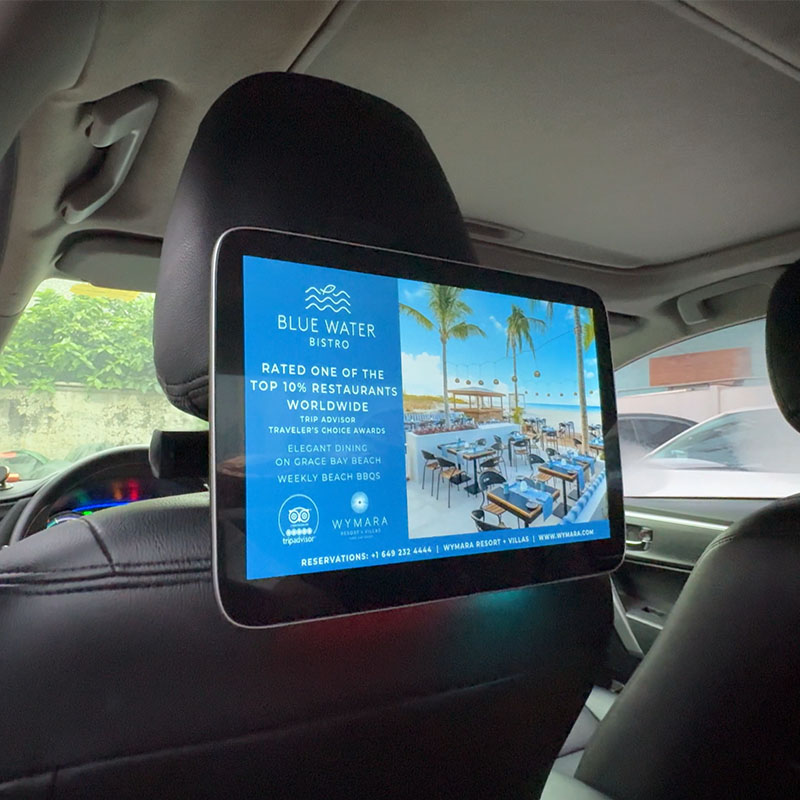
How to Choose the Best Positioning Solution for Taxi Headrest Advertising Displays
Location awareness has become one of the most valuable features of modern taxi headrest advertising displays. As digital advertising continues to replace traditional printed media inside taxis, advertisers increasingly expect advertisements to appear at the right place and at the right time.
However, many buyers misunderstand what “positioning” actually means. Some expect their taxi advertising display to provide real-time vehicle tracking, while others only need the display to automatically switch advertisements when the vehicle enters specific commercial areas such as airports, shopping malls, business districts, tourist attractions, or railway stations.
Although these two functions appear similar, they are built on completely different technical architectures and have significantly different operating costs. Understanding these differences before purchasing a taxi headrest screen can save considerable investment while ensuring the advertising system performs exactly as expected.
Table of Contents
- Why Positioning Matters in Taxi Advertising
- Two Different Positioning Requirements
- Real-Time Vehicle Tracking
- Location-Based Advertisement Playback
- Three Positioning Technologies
- GPS vs 4G vs WiFi Comparison
- Our Recommendation
- Frequently Asked Questions
Why Positioning Matters in Taxi Advertising Displays
Today’s taxi digital signage systems do much more than simply play videos. They have evolved into intelligent advertising platforms capable of displaying different campaigns based on vehicle location, time schedules, passenger behavior, and advertising priorities.
For example, a taxi driving near an international airport may automatically display advertisements for airlines, hotels, travel agencies, currency exchange services, or airport shuttle providers. Minutes later, after entering a downtown shopping district, the same taxi advertising screen can switch to luxury brands, restaurants, department stores, or entertainment venues.
This type of location-based advertising dramatically improves advertisement relevance, increases customer engagement, and delivers better return on investment for advertisers.
However, many customers mistakenly believe achieving these functions requires continuous GPS tracking. In reality, most advertising applications do not require real-time tracking at all.
Understanding the Two Different Positioning Requirements
When discussing positioning for a taxi advertising system, customers usually have one of the following objectives:
-
Real-Time Vehicle Tracking
The operator wants to know the precise location of every taxi at any moment. Vehicle coordinates are continuously uploaded to the CMS server, allowing managers to monitor routes, movement history, and fleet operations. -
Location-Based Advertisement Playback (Geofencing)
Instead of monitoring the vehicle itself, the advertising display simply recognizes that it has entered a predefined geographic area and automatically switches to specific advertising content.
Although both functions involve positioning technology, they require completely different hardware resources, software architecture, server infrastructure, and operating budgets.
Option One: Real-Time GPS Tracking
Real-time positioning continuously uploads GPS coordinates from every taxi headrest advertising display to a cloud-based Content Management System (CMS). The location is refreshed at regular intervals—sometimes every few seconds—to allow operators to monitor vehicle movement live.
Advantages of Real-Time Tracking
- Live vehicle monitoring
- Fleet management
- Route history playback
- Driver management
- Vehicle dispatch optimization
- Emergency vehicle location
These functions are extremely useful for transportation companies, logistics providers, ride-hailing platforms, and fleet management businesses.
Challenges of Real-Time Tracking
Despite its advantages, real-time positioning introduces significant operating costs that many advertising projects do not anticipate.
- Continuous GPS communication
- High mobile data consumption
- Frequent communication with CMS servers
- Power consumption increases
- Large cloud database storage requirements
- Reverse geocoding service fees
- Higher server maintenance costs
Perhaps the largest hidden expense comes from reverse geocoding services. GPS coordinates alone only provide latitude and longitude values. To convert those coordinates into meaningful locations such as streets, shopping centers, airports, or commercial districts, the system must call a reverse geocoding service provided by a mapping platform.
When thousands of taxis upload their location every few seconds, the number of API requests becomes enormous. Most commercial mapping providers charge according to usage volume, making long-term operating costs substantially higher than expected.
For this reason, real-time positioning is generally recommended only for professional fleet management systems rather than standard taxi advertising displays.
Option Two: Location-Based Advertisement Playback (Geofencing)
For most digital advertising projects, geofencing is a far more practical and cost-effective solution.
Instead of continuously transmitting GPS coordinates to the CMS, the taxi passenger screen simply determines whether the vehicle has entered a predefined advertising zone.
Once the vehicle reaches that area, the advertising display automatically switches to the assigned advertising playlist stored locally on the device. Because this decision is made internally, no continuous communication with the CMS server is required.
As a result, advertisers receive intelligent location-based advertising while operators avoid the high communication costs associated with real-time GPS tracking.
Typical Geofencing Applications
- Airport advertising campaigns
- Shopping mall promotions
- Restaurant advertisements
- Hotel promotions
- Tourist attraction marketing
- Business district campaigns
- University advertising
- Hospital advertising
- Real estate promotion
For these applications, positioning accuracy within a few meters is unnecessary. The advertising display only needs to determine whether it has entered the target commercial area.
This makes geofencing the preferred positioning technology for most taxi LCD advertising displays.
Contact Us
Looking for a reliable Taxi Headrest Advertising Display manufacturer or a customized taxi digital signage solution? Our experienced team is ready to help you choose the most cost-effective advertising display system for your fleet.
WhatsApp: +86 13422871594
Email: kiki@donghebao.com
Learn more about our products:
Taxi Headrest Advertising Display