

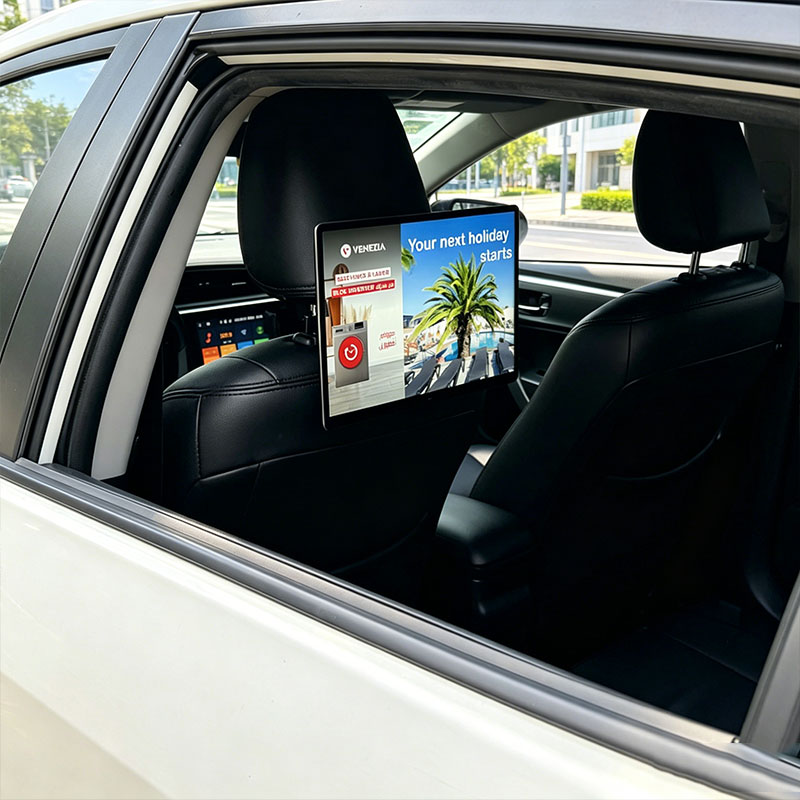
Taxi Digital Signage: 7 Key Differences Between GPS and 4G Positioning
As the demand for intelligent transportation advertising continues to grow, taxi digital signage has become an essential platform for delivering targeted and dynamic advertising campaigns. Modern taxi advertising systems are no longer limited to playing scheduled videos. Instead, they can display different advertisements based on time, location, and passenger scenarios, helping advertisers maximize campaign performance while increasing revenue for fleet operators.
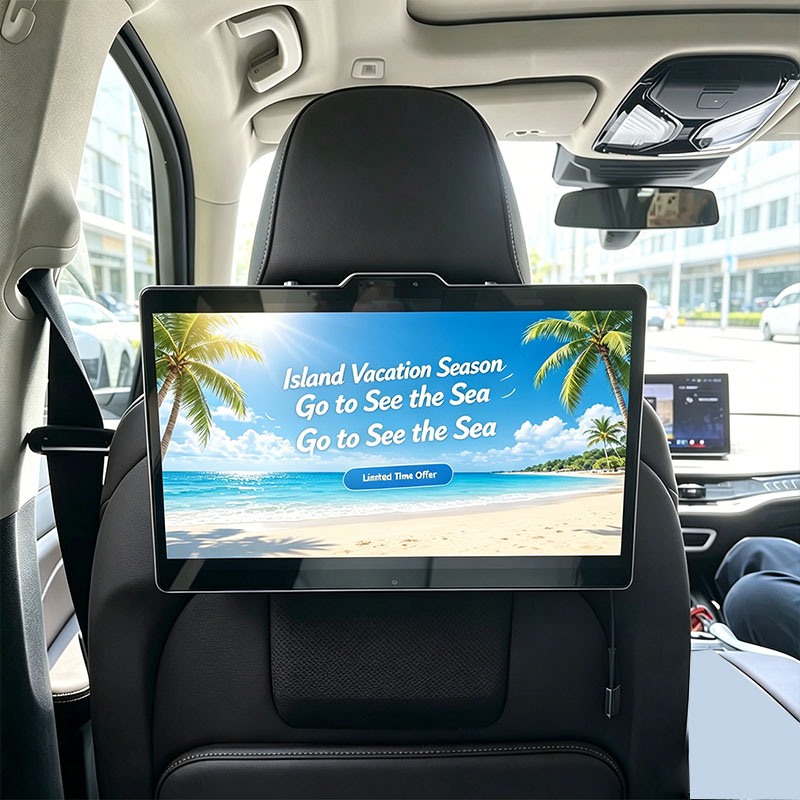
One of the most important decisions when deploying a taxi advertising system is choosing the right positioning technology. The two most common options are GPS positioning and 4G base station positioning. Although both technologies can support location-based advertising, they differ significantly in hardware requirements, operating costs, positioning accuracy, and CMS integration. Understanding these differences will help you select the most cost-effective solution for your project.
What is GPS Positioning?
GPS positioning uses satellite signals to determine the exact location of a vehicle. A taxi headrest advertising display equipped with a GPS module continuously receives signals from satellites and calculates latitude and longitude coordinates. These coordinates can then be uploaded to the CMS, allowing administrators to monitor vehicle locations in real time.
This technology is widely used in fleet management, ride-hailing platforms, logistics companies, and public transportation because it provides highly accurate vehicle tracking. Fleet managers can view live locations, analyze historical routes, optimize dispatching, and improve operational efficiency.
However, for advertising applications, such high positioning accuracy is often unnecessary. Continuous GPS communication also increases hardware costs, mobile data usage, cloud storage requirements, and reverse geocoding expenses.
What is 4G Base Station Positioning?
Unlike GPS, 4G positioning estimates a vehicle’s location by identifying nearby cellular base stations. Since every taxi passenger screen already uses a 4G network to communicate with the CMS, no additional GPS hardware is required.
Although 4G positioning is less precise than satellite positioning, it is generally accurate enough for location-based advertising and geofencing. For example, when a taxi enters an airport, shopping mall, business district, or tourist attraction, the advertising display can automatically switch to a predefined advertising playlist without requiring continuous GPS tracking.
Because positioning decisions can be processed locally by the advertising display, mobile data consumption remains low, making 4G positioning one of the most cost-effective solutions for taxi digital signage.
7 Key Differences Between GPS and 4G Positioning
1. Positioning Accuracy
GPS provides meter-level positioning accuracy and is suitable for applications requiring precise vehicle tracking. In contrast, 4G positioning determines the approximate location based on nearby cellular towers. While less accurate, it is more than sufficient for triggering advertisements within predefined commercial zones.
2. Hardware Cost
GPS positioning requires additional GPS modules, antennas, and supporting hardware, increasing the initial investment. 4G positioning relies on the existing communication module already installed in most taxi LCD advertising displays, resulting in lower hardware costs.
3. Mobile Data Consumption
Real-time GPS tracking continuously uploads location information to the CMS, consuming significant mobile data. By comparison, 4G positioning only checks whether the display has entered a target advertising area, dramatically reducing data usage.
4. CMS Integration
GPS tracking requires the CMS to process frequent location updates, maintain historical route records, and perform reverse geocoding. A geofencing-based 4G solution performs most positioning tasks locally, reducing server workload and simplifying CMS architecture.
5. Reverse Geocoding Costs
GPS coordinates must be converted into readable addresses using reverse geocoding services. Most commercial mapping providers charge API fees based on request volume. Continuous GPS uploads can therefore generate substantial long-term operating costs. Since 4G positioning requires fewer location updates, these expenses are greatly reduced.
6. Advertising Performance
For advertising purposes, accuracy within a few meters is usually unnecessary. Advertisers only need to know when the vehicle has entered a target area such as an airport, shopping mall, financial district, or railway station. In these scenarios, 4G positioning provides excellent performance at a fraction of the cost.
7. Best Business Applications
GPS positioning is ideal for fleet management, logistics, emergency services, and transportation monitoring. On the other hand, 4G positioning is better suited for digital signage for taxi, location-based advertising, geofencing campaigns, and intelligent content scheduling.
GPS vs 4G Positioning Comparison
| Feature | GPS Positioning | 4G Positioning |
|---|---|---|
| Positioning Accuracy | High | Medium |
| Hardware Cost | Higher | No Additional Hardware |
| Mobile Data Usage | High | Low |
| CMS Workload | Heavy | Light |
| Reverse Geocoding Cost | Higher | Lower |
| Fleet Management | Excellent | Limited |
| Location-Based Advertising | Good | Excellent |
Which Positioning Solution Should You Choose?
If your primary objective is real-time fleet management and route monitoring, GPS positioning remains the preferred solution because of its high accuracy and comprehensive tracking capabilities.
However, if your goal is to deliver intelligent location-based advertising through a taxi advertising display, 4G base station positioning offers the best balance between functionality and cost. It eliminates the need for dedicated GPS hardware, minimizes mobile data usage, reduces reverse geocoding expenses, and simplifies CMS deployment while still providing reliable geofencing performance.
Many of our international customers have successfully adopted 4G positioning for their taxi digital signage projects because it delivers the highest return on investment without compromising advertising effectiveness.
Related Articles
- How to Choose the Best Positioning Solution for Taxi Headrest Advertising Displays
- Complete Guide to Taxi Advertising Systems
- Taxi Headrest Advertising Display Solutions
External Resources
Contact Us
Looking for a reliable taxi digital signage manufacturer or a customized taxi advertising solution? Our experienced team is ready to help you choose the most cost-effective positioning technology for your fleet.
WhatsApp: +86 13422871594
Email: kiki@donghebao.com